Written the week of May 4-10, 2026
It’s a long way to go for a rainout.
Ellen and I traveled to Springfield, Missouri, this week to watch the first 3 games of the 6-game series between the Corpus Christi Hooks and the Springfield Cardinals. Monday was our travel day, and it started at 3:30 AM and ended 16 hours later. The Hooks’ travel started on Sunday evening at 6:30 PM and ended the next morning at 8:30 AM. We all had a long drive to get to the ballpark.
Before I get to the games, let me start with a little Texas League history lesson. I got most of this information from conversations at the stadium. The Cardinals settled into Springfield’s Hammons Field in 2005, the same year the Hooks arrived in Corpus Christi to play at Whataburger Field.
On Tuesday, the Hooks were scheduled to play the Cardinals in the newly renamed Route 66 Stadium. It didn’t take too many conversations to realize the change was met with resistance. I can only imagine the uproar in Corpus Christi if Whataburger Field became anything else.
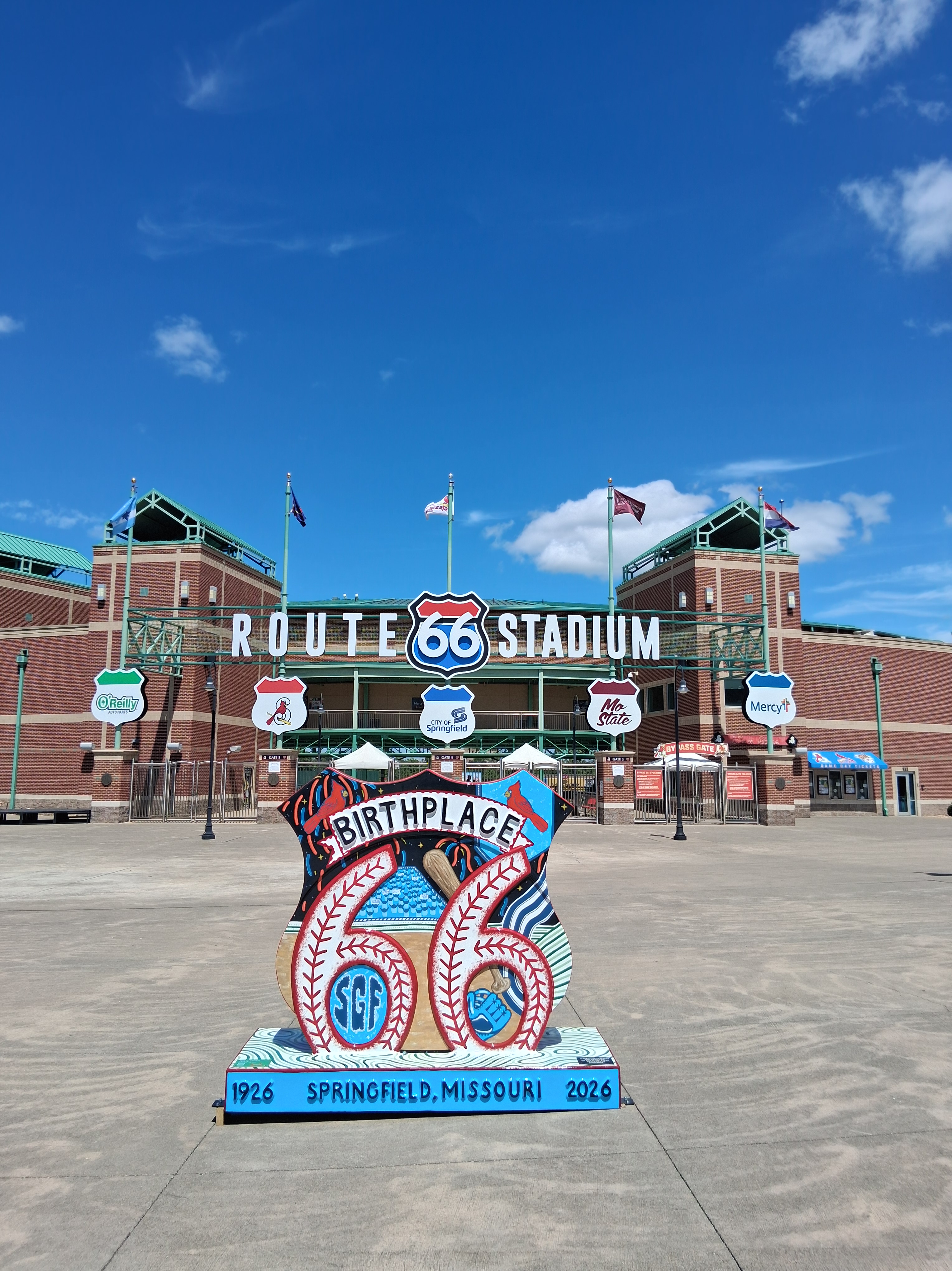
The first game would have to wait another day due to the cold, wet weather on Tuesday. I waited outside the gate for about 15 minutes before a stadium official opened the gates to say, “The game’s been canceled.”
I didn’t see a game that night, but I did get the poster celebrating the newly named stadium. It’s kind of cool that the Hooks are now the answer to a Texas League trivia question: Who opposed the Springfield Cardinals in the first game played at Route 66 Stadium?
I just wish they were the answer to another question: What team won the first game played at Route 66 Stadium?
In game 1, the Hooks did several uncharacteristic things that led to the loss.
A typical pitching day might have a tough time early, giving up runs, but things usually settle down to post zeroes the rest of the way.
Our best example of this is also our worst example of this. In the second game of the season, a 10-2 loss to Frisco, pitching went 4 scoreless innings to start the game and 4 scoreless innings to end the game. In the 5th inning, the Hooks pitchers hit a rough patch to the tune of 10 runs.
Game 1 in Springfield pitching had rough patches in the 2nd, 6th, and 8th innings. Some poor defensive plays joined the pitching struggles and resulted in a 10-6 loss. Our defense tallied a total of three errors, the most this season. Somehow Springfield had five errors but survived to get the win.
Toward the end of the game, a man came to our seats and said, “I suppose y’all are Hooks fans.”
He had on a Hooks ball cap and sweatshirt, which meant Ellen and I weren’t the only Hooks fans in the ballpark.
Jim Cologna introduced himself as the father of the Hooks development coach, Jeremy Cologna. I learned a lot about our coach by listening to his father. Jeremy has coached in the Mets’ farm system, in the Astros’ farm system, at Missouri State University, in the Cape Cod League, and in the Arizona fall league. He was a catcher in his playing days.
I don’t need Google when I’ve got a parent to tell me these things.
As I said earlier, the Hooks lost the first game 10-6, with the pitching staff giving up 6 earned runs. A dropped fly ball that would have ended the 8th inning allowed the Cardinals to continue to bat and score 3 more runs. Again, defense and spotty pitching combined to give up 6 earned and 4 unearned runs, the latter being the difference in the loss.
On Thursday, the Hooks and Cardinals played a doubleheader, with Springfield taking the first game 4-3 and Corpus Christi the second, 4-2.
Concerning the first game of the doubleheader, some things just did not go the Hooks’ way. In the 4th inning, the Hooks took a 2-0 lead, but they gave it up after an error led to a 2-out, 3-run home run that gave Springfield a 3-2 lead. A questionable safe call at second, in other words a bad call, put a player in scoring position who’d eventually score on a sacrifice fly in the 5th. That proved to be the difference between a win and a loss.
Two great moments happened during the first game of the day. Bryce Mayer struck out a batter, then Will Bush nailed the runner trying to steal third, a strike-em-out, throw-em-out double play to end the first inning.
In the 4th inning, Yamal Encarnacion hit a single, then got to 3rd base on a well-executed hit and run play as Garrett Guillemette singled.
In a hit and run, the runner starts toward 2nd base like he’s stealing. The difference between an outright steal and a hit and run is what the batter does. In a steal, the batter lets the pitch go by, whether it’s a ball or a strike. In a hit and run, he has to swing.
At that moment, the shortstop goes to 2nd base to catch the throw from the catcher and tag the runner. That leaves a big hole in the defense, which the batter exploits, and that is exactly what happened in game one of the doubleheader. Guillemette hit the ball to the spot the shortstop had just vacated.
The hit and run play is a rare feat in baseball these days, and a beautiful thing to see when it happens, especially if it’s the Hooks.
Two days in a row, a Hook player robbed himself of a hit. How do you rob yourself of a hit? You hesitate after making contact.
In the first situation, the player made great contact down the third-base line. I looked to see how far down the baseline our batter had run, because I knew it was going to be a close play at first—and it was! The problem was the batter remained in the batter’s box until he saw the third baseman field the ball in fair territory. He shot down the line, only to be called out by a hair.
The next day, another Hooks player hit a line drive to the shortstop, took a jab step toward first, slowed up, then blazed down the line when he realized the ball hadn’t been caught in the air. He too missed being safe by half a step.
I’m reminded of Sean Casey’s embarrassing story of being thrown out at first base by the left fielder. At the time, he played for the Detroit Tigers. He got a solid hit just over the shortstop’s glove, but he thought the ball was caught. He started out toward first, stopped with shoulders slumped, headed toward the dugout, heard his teammates yelling to run, and ran in desperate dread. The White Sox left fielder fired to first for the only 7-3 out in Major League Baseball history. At least I can’t imagine that happening twice.
By the way, the numbers 7-3 represent the players involved in the out. The first number represents who threw the ball, the left fielder, and the second represents who caught it, the first baseman. Every defender on the field, from the pitcher, #1, to the right fielder, #9, has a designated number.
In game 1 on Wednesday, Jim Cologna, Ellen, and I were the only Hooks’ fans in the stands. At Thursday’s first game, Hooks fans might have outnumbered the home fans. Bryce Mayer, who grew up in Missouri, was our starting pitcher, and his family showed up by the dozens. Meeting family is always a pleasure. The second Thursday game still had a number of Hooks fans in the stands, but a whole lot fewer, as Bryce’s family headed home.
I recall a major league game in Milwaukee that pitted the Houston Astros against the Chicago Cubs. Miller Park was also known as Wrigley II because Cub fans from Chicago easily drove the short distance to Milwaukee when the Cubs played the Milwaukee Brewers.
In September 2008, Houston had to move their home series to Milwaukee due to the damage caused by Hurricane Ike. The result was that out of the 10,000+ fans who made the September 15th game, you could count the Astro fans using only fingers and toes. I described the experience of being an Astro fan in a sea of Cub fans as feeling like I had worn a pink tutu to the ball game.
We were easy to spot in our bright orange jerseys, so a kindly older woman walked along the third base side of the stadium shaking each Astro fan’s hand. She said to me, “Thank you so much for supporting the Astros.”
She was Elizabeth McClane, wife of the owner, Drayton McClane. I usually get a player to sign my game ticket, but I had her sign that day. I had a great conversation with her before the game and met her husband a little later, shaking his hand and saying, “I appreciate what you’ve done with the team.”
Back to the Hooks’ game. Our seats were so close to the visitors’ dugout, that I could see and hear what the coaches were doing during the game. Ellen noticed Jeremy Cologna flashing numbers with his fingers to someone, but we couldn’t quite figure out who. In time, we learned he was sending signals to the catcher, and later found out they directed the defensive schemes on the infield—i.e., shortstop takes the throw at second in a steal attempt, first baseman covers first for a quick throw from the catcher, etc.
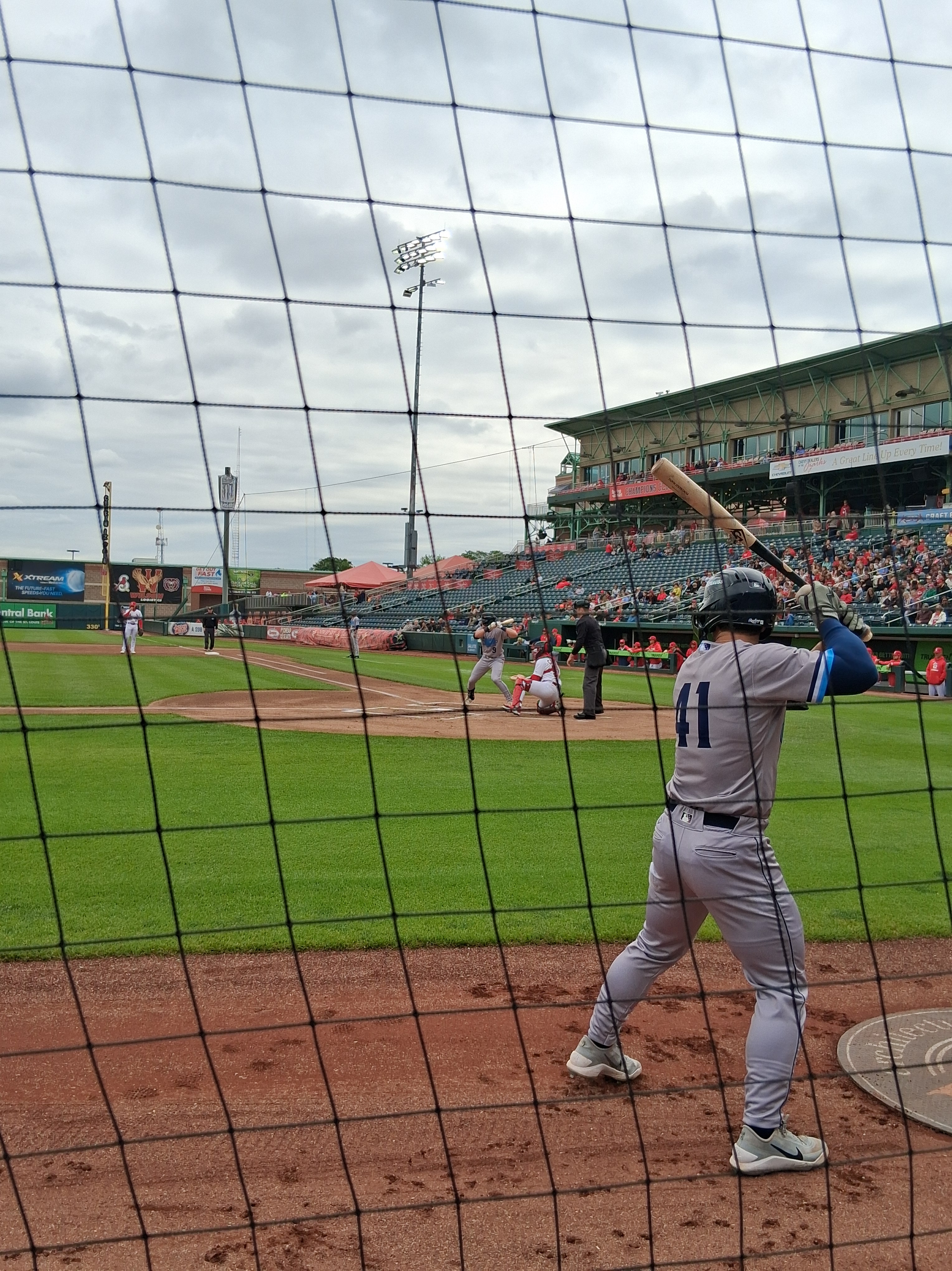
Trevor Austin On Deck
The Hooks ended up going 2-4 over the series in Springfield, but they could have easily gone 5-1 for the week. The last game I deemed unwatchable from the 7th inning on, and the team didn’t look good at all, but the rest were winnable.
Over the week, the quirky ball bounces often did not go in the Hooks’ favor. A hit bounces over the 1st baseman’s glove; two players converge on a 3rd out but both ease up, allowing a hit; an error is followed by a 3-run home run; a potential double-play ball bounces off the pitcher’s leg into right field; a missed call at second opens the door for the winning run to score; a key player goes out after being injured sliding into 2nd; a 7th inning 5-4 lead turns into a big inning for the Cardinals and we end up trailing 9-5.
This is not a litany of gripes and excuses, but a reminder that the difference between winning a game and losing it sometimes comes down to which way the ball bounces. This past week was not kind to the Corpus Christi Hooks.
In looking at the team stats, they confirm what I saw on the field. The pitching moved out of the penthouse this week. And even though the hitting continued its upward trek, our batters showed a disturbing trend that caused our pitchers to pack their bags and move out of the #1 spot in strikeouts. The team that took that spot? The Springfield Cardinals.
In going through the box scores, the numbers shocked me. I knew we’d been bad, but abysmal better describes our poor performance at the plate. The Hooks struck out 68 times versus 37 times for the Cardinals. Those 31 extra strikeouts moved the Cardinal pitching staff into the Texas League lead, 343 to our 334.
Despite the strikeouts, somehow our guys did get plenty of hits, 50 to their 46, which moves us up another rung, from #9 to #8, in team batting average. That is a +.011 improvement from last week’s .220 to this week’s .231. I hope I’m not getting too much in the weeds here, but I do want to track trends, and this is a great one.
What I see is a team this past week that pitched poorly, had shaky defense, and struck out a lot, while getting more hits and improving their overall offensive output. The thing that hurts or helps their win chances is how they hit with runners in scoring position (RISP). RISP represents base runners on 2nd or 3rd base, the two bases where a single into the outfield will likely score a run.
In their one big win, the Hooks got 15 hits and went 6-14 with runners in scoring position. They had more opportunities, took advantage of those opportunities, and won.
In a close loss, the Hooks left 10 runners on base, a definitively poor showing at the plate. We had 7 more runners in scoring position over the course of the game than Springfield and did not take advantage of those opportunities. We lost by a single run, 4-3.
In watching the last game of the series, an 11-5 loss, I heard the Cardinals analyst say something that can partially account for what I saw on the field. “It looks like the Hooks are going to lose this game, and they’ll have a 14-and-a-half-hour ride home to think about it.”
He commented that it’s the Hooks’ longest bus ride of the season, a fact I can attest to from our Monday drive up to Springfield. The drive wore me out for a few days and could account for some of the uncharacteristic mistakes the team made this week in Springfield.
They will have the next two weeks at home to play the current top two teams in the South Division.
By the way, the Frisco series go-to-guy, Tommy Sacco Jr., is gone. On May 7th, he moved up to Triple A Sugar Land. Alberto Hernandez and Max Holy moved up this week to the Corpus Christi Hooks from High-A Asheville. Max doubled in his first at bat at the Double A level. He is looking like a potential go-to-guy.
Let me end with a quote that sums up my feelings after a tough week with the Hooks:
But there’s one thing I know;
The blues they send to meet me won’t defeat me.
It won’t be long ’till happiness steps up to greet me.
—Burt Bacharach
Corpus Christi Hooks 6-Springfield Cardinals 10 L
Corpus Christi Hooks 3-Springfield Cardinals 4 L
Corpus Christi Hooks 4-Springfield Cardinals 2 W
Corpus Christi Hooks 11-Springfield Cardinals 8 W
Corpus Christi Hooks 5-Springfield Cardinals 7 L
Corpus Christi Hooks 5-Springfield Cardinals 11 L
Texas League South standings
Midland 20-13
Amarillo 16-16
Frisco 16-16
Corpus Christi 15-18
San Antonio 11-22


Leave a Reply