Written the week of April 6-12, 2026
This week the Hooks travel to San Antonio for a six-game series.
For longtime Hooks fans, you know about the league. I’m writing the next two paragraphs for the person who doesn’t know much if anything about the Hooks or the Texas League.
Now getting you oriented as to how the Texas League is set up. It has two divisions, the North and the South. Corpus Christi is in the South Division with four other teams. I’ll include their cities, names, and major league affiliations.
The San Antonio Missions, this week’s opponent, are the Double-A affiliate of the San Diego Padres. The Frisco RoughRiders, last week’s foe, are the Texas Rangers’ Double-A affiliate, the Amarillo Sod Poodles are the Arizona Diamondbacks’ Double-A affiliate, and the Midland RockHounds are the Athletics’ Double-A affiliate.
Next week I’ll cover the North Division when Northwest Arkansas visits Whataburger Field.
Let’s get to those changes suggested by this chapter’s title. I’ve seen some significant ones since arriving in Corpus Christi in 2016.
In 2019, Amarillo added a new team to the Texas League. AI Overview says about that team, “The Amarillo Sod Poodles [have been] the Double-A affiliate of the Arizona Diamondbacks since 2019,” but that’s wrong.
How do I know it’s wrong?
The Missions moved to Amarillo in 2019, taking a 2-year hiatus from San Antonio, and played there as the Sod Poodles during the inaugural season at Hodgetown, the Sod Poodles’ new ballpark. The Soddies were crowned the 2019 Texas League champions.
That was one of the changes I’ve personally witnessed. With that move, the nearest away game for the Hooks went from Nelson W. Wolff Municipal Stadium, a two-hour drive from Corpus Christi, to a six-hour-plus drive, Riders Field, home of the RoughRiders. The drive to Amarillo was and is much farther, nine and a half hours. I’m grateful that, in 2021, after a Covid-related extended offseason in 2020, the Padres returned their Double-A affiliate to San Antonio.
Related to that, in 2021, the Arizona Diamondbacks moved their Double-A team to Amarillo. That added a fifth team to the previous four-team South Division, and expanded the Texas League from 8 teams to 10. Somewhere in all of that shuffling, Minor League Baseball renamed the Texas League, as well as other minor league divisions, to something more generic and less memorable. I, for one, won’t even take the time to ask AI Overview what those names were.
I’ve collected baseballs from different venues: college games, major league games, and minor league ones. Each NCAA baseball conference has its own baseball—Big XII, Big 10, SEC, etc. I think at one time the National League and the American League had different logos. Now all bear the logo OFFICIAL MAJOR LEAGUE BASEBALL.
I’ve collected minor league baseballs from the Pacific Coast League, the Midwest League, the Pioneer League, and, of course, the Texas League. I know this because each league in the past stamped its name on the baseballs used in that league. That changed post-Covid, and all minor league baseballs now bear the stamp OFFICIAL MINOR LEAGUE BASEBALL.
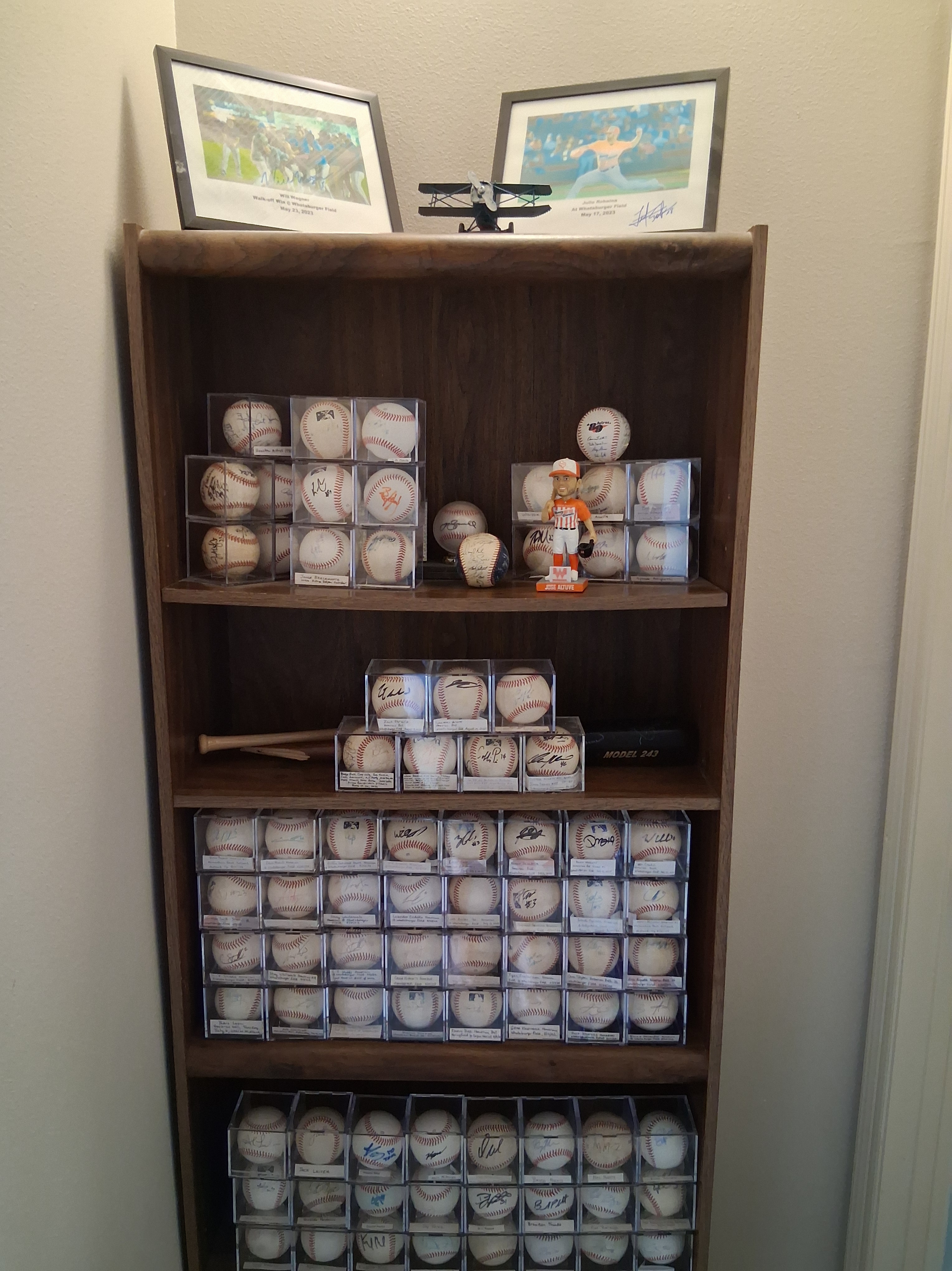
All my research on this subject was limited to my personal collection on top of my bedroom dresser and one bookcase where some of my 200+ baseballs can be found. I remember seeing a picture of a friend’s office filled with baseballs and baseball memorabilia. At the time, I wondered how in the world he collected so much baseball stuff. Now I know the answer.
Let’s shift gears a bit from the personal to the more general when it comes to changes in baseball.
The minor leagues are where Major League Baseball tinkers with the rules. The pitch clock implemented in 2023 at the MLB level started its development in 2015 at the Double-A and Triple-A levels and expanded to all full-season minor league levels in 2021 and 2022. I’m relying on AI Overview for the dates, but I remember watching games as the debate raged around the pitch clock’s use. Its implementation has shortened the game.
I learned about the new rule dealing with extra innings while watching a Sunday afternoon Hooks’ game. I noticed the opposing team had a player standing on second base in the top of the tenth, and I asked a friend, “Why’s there a guy on second?”
He and I were both puzzled, feeling like we’d missed the first batter’s hit. When it happened with a Hooks player in the bottom of the same inning, we both remained mystified. How could we miss two important at-bats during a close game?
After the game, an informed source told us about how they had implemented a new rule to shorten extra-inning games. The person who made the last out in the ninth inning would start as a baserunner on second in the tenth. If additional innings are necessary, the same principle applies. The rule now exists at the major league level.
Last year I witnessed the Automated Ball-Strike (ABS) System at work when in Sugar Land for a Triple-A game. ABS was being tested in a limited number of Triple-A stadiums in 2025. Constellation Field, home of the Space Cowboys, happened to be one of those stadiums.
Is this replacing human umpires? Not at all. It is simply a way of confirming or correcting the plate umpire’s calls. If you think it hurts the game, that it’s not natural, my wife would strongly agree.
Me? I’ve seen the system in action, and I like it. A team gets two challenges at the start of a game. They can challenge as much as they’d like, as long as they win the challenge. Two wrongs and they’re out of challenges.
A tap on the cap or helmet after a call signals the challenge. The home plate umpire acknowledges the challenge, and ABS reviews it. It comes up almost immediately on the big screen scoreboard. The whole process seems to take only seconds, from challenge to final result. Major League Baseball now uses ABS in all major league stadiums.
Covid provided impetus for the most significant changes in minor league baseball. Prior to 2020, teams played three- and four-game series throughout the season. Corpus Christi might end a three-game series at home one night only to turn around and play a four-game series in Frisco the next night. I remind you, that’s a 6-plus-hour drive. In looking at the Hooks schedule in May of 2018, I noticed how little time players had off, only two days for the entire month.
In looking at the 2018 schedule, I noticed something else that had escaped me at the time. If the team played a South Division foe, the series went four games, and against a North Division team, three games. At the time, the schedule seemed arbitrary to me, but it wasn’t.
That schedule happened prior to the lost season due to Covid. Now it is standardized across all minor league levels. Every series is a six-game series, starting on Tuesday and ending on Sunday. Monday is a day off for all minor league teams. Due to the fact that the lower minor league levels travel by bus, teams who must travel leave for the next series as soon as Sunday’s game ends, or Tuesday morning, if the next venue is close. For the Hooks, the latter is true only when they play the San Antonio Missions, which means I get to go to an away game this week.
Thanks to being a season ticket holder, one of the perks I receive is free tickets to away games, if those games involve the Hooks. I’m in San Antonio right now, April 9th, and taking advantage of that gift. Of course, that doesn’t include food, lodging, and the cost of gas.
Last night’s game went into extra innings where Corpus Christi won in the 11th inning. In reading the highlights, the game was one I’d have enjoyed, not because my team won, but because it had outstanding relief pitching, a Hooks homerun in the second by First Baseman Will Bush, and two throws from Center Fielder Lucas Spence for outs at third base. I love outs thrown from the outfield, even if it’s by an opponent.
Tonight I showed up early and walked around the outside of Wolff Stadium until the gates opened. I talked with Ruth, a long-time Hooks fan living in San Antonio, Robert, a stadium usher, and Wayne, one of the camera people. He asked me an odd question. “You wouldn’t happen to have an Android power cable, would you?”
I did, so I went to the car to fetch it for him. I retrieved it from Wayne in the bottom of the ninth. I figured he had enough juice to finish the game. Retrieving the cable offered me a chance to talk to a few of the Hooks players.
John Garcia is one of four catchers on our roster, and he and I talked about the season. I was looking at our roster as being full of veterans, but he had a different perspective.
Let’s start with my perspective, which I’ve already noted in the first chapter. Since I am familiar with 75% of the players because they were all here at the end of the 2025 season, I see it as filled with veterans.
For John, a team veteran is a player from last year who was with the Hooks early in the season. Some remained to the end. Others moved on in some way—promoted to Triple-A, demoted to A ball, released, traded, etc.
Players like Joseph Sullivan and Lucas Spence came in August or September. They were with the Hooks but only toward the end. The fact that they ended the season with the team made them veterans in my eyes but not John’s. Gelling as a team takes time, and that doesn’t happen in the last month of the season.
Some thoughts from Thursday night’s game.
When I talked to John, I asked him how we scored our first run. I happened to be texting my wife about my great seat, third row, when I looked up and saw the first base umpire signal a balk and point to second base.
What I didn’t see was our runner at third. When the pitcher walked the next batter, I expected to see bases loaded. Instead, I saw third base empty, looked at the number of outs, zero, the number of runs, one, and wondered if Sullivan had stolen home while I was texting. He hadn’t, but had been given a base, home plate, because the pitcher balked.
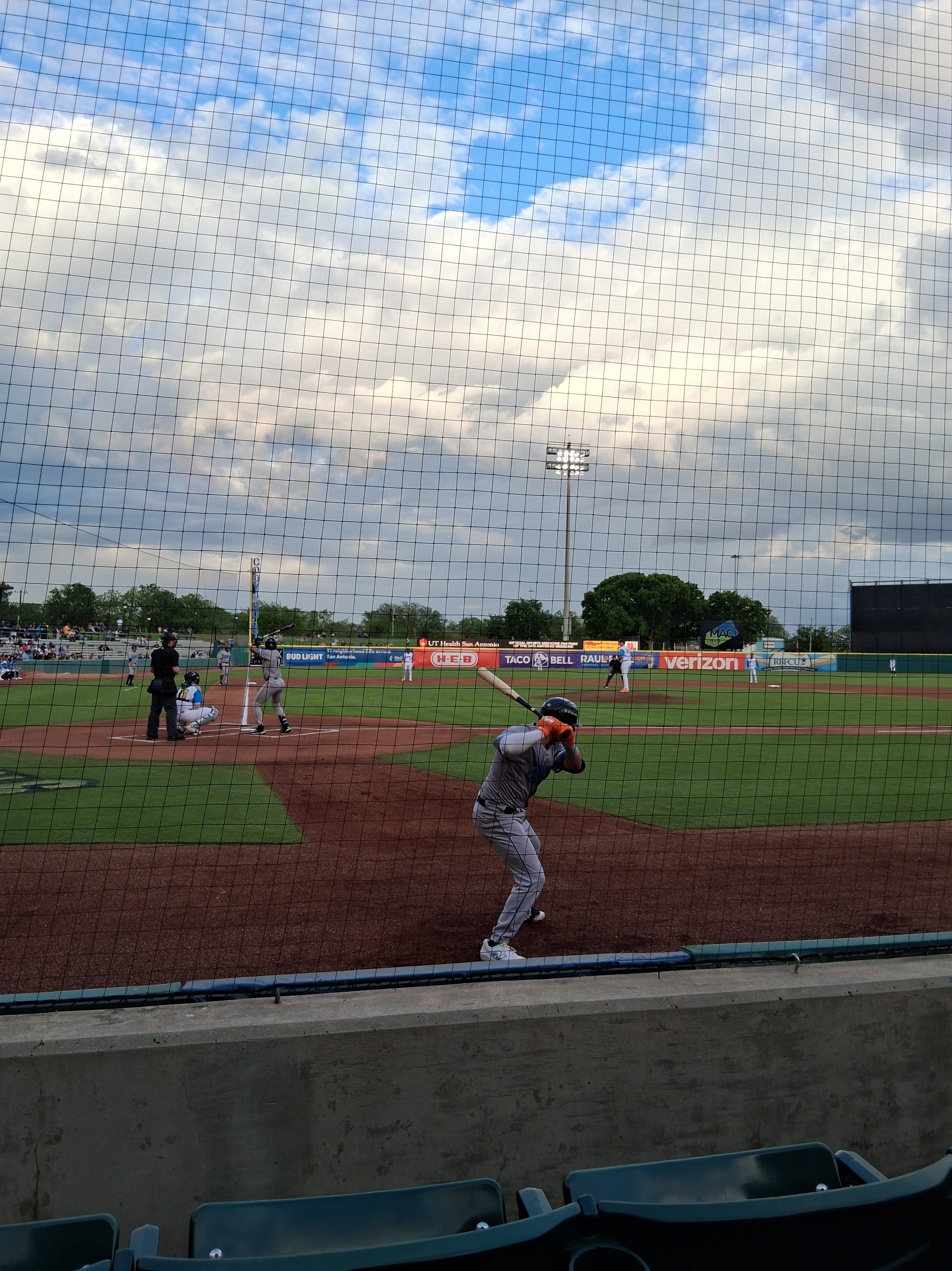
Later I was paying attention when the Hooks scored again. My third-row seat was in line with the third-base foul line. When Yamal Encarnacion, our second baseman, hit the ball down the third-base line, I groaned. I had a clear view of where it hit and saw it bounce just foul.
The San Antonio crowd groaned too when the umpire signaled fair ball, and the Hooks scored two runs.
Will Bush, another catcher on the Hooks, is having a solid start to the season. He’s hitting .400 with an OPS of 1.171. OPS, in case you’re wondering, is On Base Plus Slugging. An .800+ OPS will get you promoted to the next level. Keep it up and you’re playing in the Major League.
I’m only noting this because of how a minor league fan might look at great stats. Me? I first think, “Wow! That’s wonderful!” I follow it up with, “Oh, man, how long is Will going to be here?”
Toward the end of the game, the last San Antonio relief pitcher, wearing #7, was consistently throwing pitches clocked at around 48 mph. He lobbed his first pitch into the dirt well short of the plate. I thought he was asking for a different ball. It wasn’t until the second and third pitches that I realized he was tossing the ball toward the strike zone and the first one had fallen short…way short!
I looked at the San Antonio roster for #7, knowing he wouldn’t be listed among the pitchers, and found the player, Chris Sargent, listed among the catchers. His pitches looked awful, but the results were decent. His only earned run came in the ninth when our second baseman hit a homerun that barely cleared the fence in the left field corner.
As you can see from the summary below of the six-game series in San Antonio, the Hooks went from 0-3 last week and last place in the South Division to 4-5, good enough for third place among the five teams.
April 7 Corpus Christi Hooks 6-San Antonio Missions 3 W
April 8 Corpus Christi Hooks 9-San Antonio Missions 6 W
April 9 Corpus Christi Hooks 10-San Antonio Missions 3 W
April 10 Corpus Christi Hooks 2-San Antonio Missions 1 W
April 11 Corpus Christi Hooks 3-San Antonio Missions 4 L
April 12 Corpus Christi Hooks 0-San Antonio Missions 1 L
That record doesn’t get you into the playoffs, but it is a good early move up the standings ladder. I’m curious as to how the Hooks will make it to the top.


Leave a Reply